


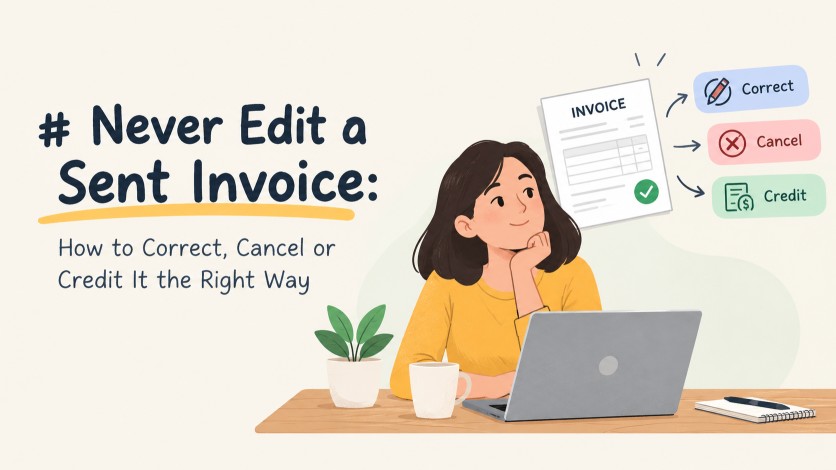
Why one mistake can create three problems, and why the correct fix changes by country.
You send a USD 2,400 invoice with the wrong tax rate. An hour later the client’s accounts team books it. Or suddenly you realise that the client’s legal name entered in the invoice is not correct. Or it can happen that the amount was paid already, but then half of the project stands cancelled.
Many businesses often make the mistake of opening their invoicing software, editing the figures on the same invoice, and resending it. This instinct is exactly what causes trouble later.
If you try to search for a solution online, most guides often say to issue a credit note and raise a fresh invoice. It is a decent default, but it skips the questions that decide whether your fix is actually valid. Was the error in a field the law requires? Has the invoice been reported to a tax system? Has it been paid? And what does your client’s finance team have to do on their side?
Let us walk you down through the guide on deciding what you should actually do, when you face a similar issue.
The one rule: an issued invoice is a record, not a draft
Do not forget that once you send an invoice to your client, it is a record for them, and becomes an evidence. The chances of the invoice sitting in your client’s ledge, in your tax return and also the government’s tax system is high. Editing or deleting it quietly will break the trail that serves as a basis to auditors, tax authorities and your own bookkeeper.
So the working principle across almost every jurisdiction is the same: you do not change an issued invoice, you add a document on top of it that explains the change. The type of document depends on what went wrong.
Step 1: Diagnose the mistake
Before hurriedly changing the invoice amount, track the issue and try to fix it.
A. It hasn’t been issued yet.
If instead of issuing the final invoice, you issued drafts, quotes or proforma invoices, they can be edited freely. A proforma is generally not a tax invoice, so you usually do not need a credit note to change it. The moment it becomes a numbered invoice, that freedom ends.
B. The invoice was wrong when it left.
Wrong client name or address, wrong tax ID, wrong tax rate, wrong tax treatment, miscalculated total, duplicate invoice. These are the mandatory invoice fields as per GST rules in India, and mistakes in any of them will require a formal correction.
C. The deal changed after the invoice.
A settlement was done after the invoice was made, goods were returned, you missed adding the extra charges or there was reduction in the scope. In such cases, even if the invoice was right at the time, the amount owed has changed.
If you cannot tell which bucket you are in, ask: was the original invoice an accurate record of what we agreed on the day I sent it? If no, it is bucket B. If yes, it is bucket C.
Step 2: Pick the right tool
Identify the right tool that you should use according to the mistake or the issue that has occurred.
- Credit note. Reduces or cancels what was invoiced. You can use the document for cancelling the original invoice, or can also be used for any agreed upon discounts and returns at a later stage. It should reference the original invoice and be clearly labelled “credit note”.
- Cancel and reissue. When you cancel the wrong invoice (with a credit note, or through a tax system’s cancellation function) and then issue a fresh invoice with a new number and the correct details. Both documents stay on record.
- Correction invoice. Some countries use a formal correction invoice. It is the same as the original invoice, or the best route to fix an wrongly issued invoice instead of a credit note. Check if your country accepts a correction invoice.
- Debit note or supplementary invoice. For undercharging, or an add-on you forgot. Never go back and raise the original total.
Step 3: Has it been paid?
A credit note changes what is owed. But it can not move money.
- Unpaid invoice: if the invoice is unpaid, by the time the mistake is spotted, the credit note cancels or reduces the balance. A corrected invoice can then be issued.
- Paid invoice, you owe a refund: if the payment was done, you can issue the credit note, then refund the money to the client. You need to make sure both are clearly linked in your books.
- Paid invoice, client will buy again: in such a situation, since you know that the dealings with the client will continue, you can keep the amount as a credit balance. Apply the same to the next invoice. Putting the same agreement in writing will help make sure there are no disputes.
- Overpaid or duplicate payment: if the client has overpaid or made the same payment twice, refund it or allocate it with the client’s agreement. Do not let it sit as unexplained cash.
Step 4: Know your country’s quirks
The principle is global. The details are not. You can find a few examples below for better understanding, and always confirm your own rules with an accountant.
United Kingdom. Guidance from HMRC treats a credit note as the way to correct or amend a previously issued VAT invoice. It must carry the same details as a VAT invoice, be clearly labelled as a credit note, and be issued within a reasonable time of the event that caused the adjustment. The VAT adjustment goes on the return for the period when you issue the credit note, so a credit note raised in one quarter against an invoice from the previous quarter reduces the later quarter’s VAT.
Germany and the EU. You can easily get lost in the terminology. In Germany, a document called a credit note (Gutschrift) traditionally refers to a document issued by the buyer to settle a supply. They use a correction invoice to fix the errors in the invoice. If you invoice across EU borders, check the terms your client’s finance team expects, or they can reject your corrected document too.
India. If your business falls under e-invoicing, the invoice is registered on the government’s portal and gets an Invoice Reference Number. Once IRN is generated, the invoice cannot be deleted or edited. You can only cancel it on the portal, and that too within 24 hours. Cancellation is all-or-nothing, so you cannot partly cancel, and the cancelled invoice number cannot be reused. After 24 hours, the only route for invoice correction is the issuance of a credit note, that should be reported in the GST return. Credit notes under GST also face a time limit tied to the financial year, so do not leave corrections to the end of the year.
United States. There is no single national rule on how to correct a commercial invoice. Practice is shaped by your contract, state sales tax rules and your accounting method. The safest habit is the universal one: never delete, always issue a linked credit memo, and keep both documents.
Step 5: What a good credit note contains
While issuing a credit note to make invoice correction, adhere to the format so that you don’t face any consequences later.
- The words “Credit note” (or the term your country uses), so it cannot be mistaken for an invoice
- Its own unique number, kept in a traceable sequence
- A reference to the original invoice number and date, to track down which invoice it belongs to
- The reason for the credit in plain words, at the bottom
- The amount credited, including tax, shown the same way the original invoice showed it
- Both parties’ names, addresses and tax IDs
- The next steps agreed on: refund, applied to next invoice, or balance cancelled
Step 6: Tell your client before they find out
This step is very important and is often missed b y most of the guides. If you forget to inform your client, the practical damage begins. Your client’s accounts team may have already approved or scheduled the original invoice. If a corrected invoice shows up without context, you risk a double payment, a rejected document or a stalled approval.
Send a short note with the documents:
- The issue with the original invoice, in one sentence
- Which invoice number is cancelled and the new number replacing it
- The net amount now due
- Ask them to void or hold the original (initial) in their system
Six mistakes to avoid
- Deleting the invoice – Deleting the invoice breaks the trail, since invoicing systems have a numbering format for all invoices generated.
- Overwriting it and resending under the same number – Two different versions of one invoice number will result in a dispute, and at the time of tax filing you will have to rush for correct details.
- Reusing a cancelled invoice number.
- Issuing a credit note for a dispute the client has not agreed to – Adjust the books only for genuine changes that the client has agreed on.
- Backdating the correction – Add current date to the documents when you issue them and explain the reason.
- Forgetting the tax return – A credit note affects the period when you issue it, hence make it a point to not forget at the time of filing returns.
The quick decision path
- No number assigned to the invoice yet? Edit it.
- Wrong when sent, unpaid? Cancel the issued invoice with a credit note or portal cancellation, then reissue.
- Wrong when sent, paid? Credit note, new invoice, then refund or offset the difference.
- Did the deal change later? You can issue Credit notes for less amount, debit notes for more.
- In an e-invoicing country? Check the cancellation window before you do anything else.
The Bottom Line
A corrected invoice is not a sign of a sloppy business. Rather an untraceable or uninformed edit shows unprofessionalism. Clients, accountants and tax authorities forgive honest mistakes that are fixed in plain sight, and communicated clearly. But they rarely forgive the ones that are hidden.
That is why Cloudtryx Invoice thinks of invoicing as record-keeping first and document design second. Every invoice should be traceable from the day it is issued to the day it is settled. Try out simple and affordable cloud invoicing software for your small business, and stay worry free every time there is a mistake while invoicing your clients.
This article is for general information and is not legal or tax advice. Rules differ by country and change often, so confirm the details for your situation with a qualified professional.