


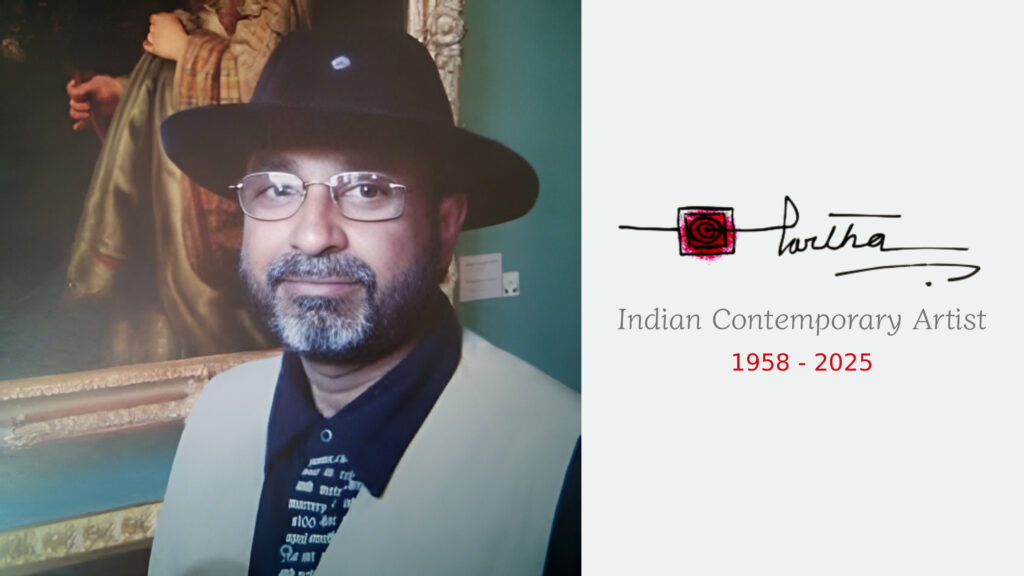
When considering an artist’s work for a serious collection, biography matters. Not as gossip or human interest — but because the life behind the work tells you whether the work is genuine. Whether the artist paid the price of the convictions the paintings express. Whether the beauty you see is hard-won or simply produced.
In the case of Partha Bhattacharjee, the biography is unambiguous on this point. He worked as a railway porter to survive while developing his art. He painted garages for money. He copied Rembrandt and Renoir in commissioned work and used those earnings to fund paintings that were entirely his own. He won the President of India’s silver plaque — the highest recognition the All India Fine Arts and Crafts Society offers — and then kept pushing, refused to rest, kept asking harder questions. He lost much of his sight to a cerebral attack in 2017, switched his medium, learned new visual languages, and kept painting until his death in 2025.
The work is genuine. The price was paid, in full, over a long time.
What the Series Tell a Collector
The Family Series of the 1980s is where you see the emotional foundation of everything that followed: oil paintings made from homesickness, from the love of a man separated from his family who could only be near them on canvas. These are not grand paintings. They are honest ones, and their honesty is already the signature of what Partha would become.
The Devi Series of the 1990s is the central achievement — the body of work for which he is most celebrated and most collected. These oil paintings, using Trompe-l’oeil to reveal the divine within the everyday, operate simultaneously as technical tours de force, as spiritual meditations, and as quietly radical political statements about the women who carry the world. The President’s award came for these.
The works of the 2010s — Mahakal Series, Jesus Series, Rural Series, Etc. — show the artist turning consciously away from European influence and toward Indian forms, adding three-dimensional materials to his canvases, speaking more directly of his convictions about peace and justice.
The Late Works: The Case for Collecting
For collectors specifically, the late works — the Companion Series, Migrant Worker Series, Rural Series, and Durga Series produced after 2017 in dry pastel and mixed media on paper — represent an extraordinary convergence of factors that are very rarely present simultaneously in a single body of work.
The artist’s full technical mastery, built over 35 years of oil painting. The cultural richness of Madhubani, Warli, Gond, and Bengal Patachitra traditions, absorbed through years of walking into India’s most remote villages. The spiritual depth of a man who had been thinking about the divine feminine for four decades. And the urgency of a man whose sight was compromised and whose time was finite, who chose to spend both in devotion to the only prayer he had ever truly believed in.
Works made under these conditions — with these stakes, at this level of cultural and biographical seriousness — do not come along often. When they do, they tend to hold their significance across time. They are not fashionable. They are not designed to be. They are honest, and honesty in art is the one quality that does not age.
A Note on Acquisition
For those interested in building or deepening a collection around Partha’s collection of Indian fine art, the available works span multiple series and mediums — from the celebrated oil paintings of the Devi and Sekal-Ekal series to the pastel folk-art works of the final decade. Details and availability can be found through Partha Bhattacharjee. These are, in the plainest terms, works worth owning — not merely as objects of beauty, which they are, but as the evidence of a life genuinely and completely lived in devotion to art.