


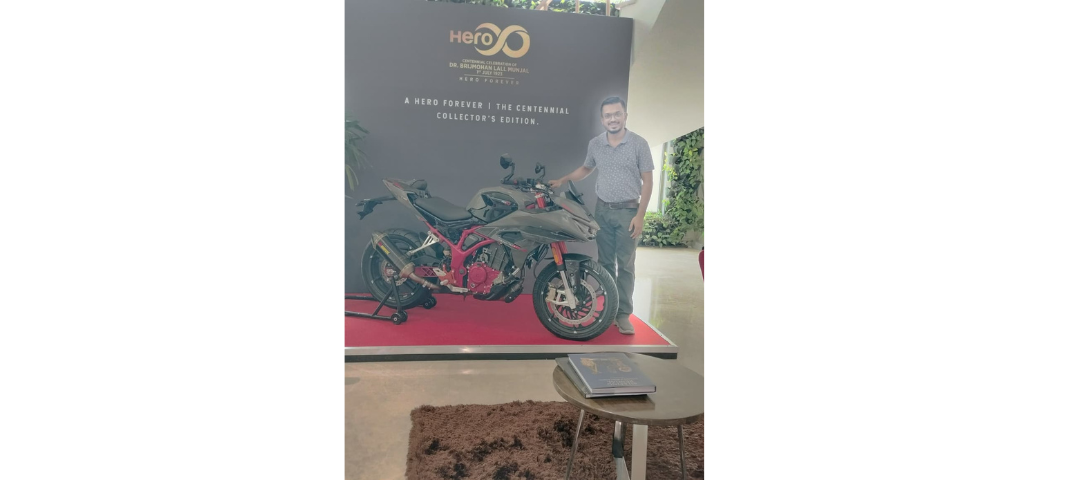
Entrepreneurship is often viewed through the lens of growth, revenue, expansion and visible achievements. But for Shoumyadeep Ghosh, Managing Director & Chairman of D S Motors, Teliamura, the deeper entrepreneurial journey is about something much more fundamental: changing the way one thinks.
Reflecting on his experience, Ghosh explains that an entrepreneur’s mindset evolves over time. In the beginning, the question is simply, “How can I make this work?” With experience, that question becomes, “How can I make this work consistently?” Eventually, it develops into a larger question: “How can I build a system that continues working even when I am not personally involved in every decision?”
For him, this shift from individual problem-solving to systems thinking represents one of the most important stages of entrepreneurial development. Success is not about repeatedly solving the same problems. It is about creating systems that prevent those problems from occurring again.

Looking Beyond the Visible Side of Entrepreneurship
From the outside, entrepreneurship can appear glamorous. People see the showroom, the designation, the business, the photographs and the achievements. What they may not see are the years of uncertainty, operational pressure, employee challenges, customer expectations, difficult decisions and continuous learning that exist behind those visible outcomes.
Ghosh describes entrepreneurship in practical terms: responsibility, consistency, problem-solving, decision-making and patience. The public generally sees the result, while the entrepreneur experiences the process—and according to him, the process is where most of the learning takes place.
This perspective also shapes his approach to risk. Rather than taking risks simply because they appear exciting, he prefers calculated risk. Before making an important decision, he considers the potential upside and downside, the assumptions involved, what can and cannot be controlled, the consequences of being wrong, the organisation’s ability to absorb the downside and the decision’s long-term strategic value.
The objective, he believes, is not to eliminate risk because that is impossible. Instead, entrepreneurs should understand risk well enough to make intelligent decisions. Sometimes taking action is the greater risk; at other times, refusing to change can be even more dangerous.
Making Decisions in an Uncertain Business Environment
Uncertainty is another unavoidable part of entrepreneurship. Ghosh believes leaders rarely have complete information when important decisions need to be made. Waiting for perfect certainty can mean missing an opportunity.
His approach combines information, experience, scenario planning and judgement. Rather than attempting to eliminate uncertainty, he focuses on making it manageable by asking what is known, what is unknown, what is likely, what is possible and what the organisation should prepare for.
The same disciplined thinking applies to emotions. Leadership cannot become completely emotionless because leaders are human. The objective, according to Ghosh, is emotional discipline. Anger should not immediately result in irreversible decisions, excitement should not lead to overestimating opportunities, and disappointment should not cause a leader to underestimate the organisation.
His principle is simple: feel everything, but decide thoughtfully.
Customers at the Centre of Business
One of the strongest themes in Ghosh’s entrepreneurial philosophy is the importance of understanding customers as human beings rather than simply buyers.
Customers, he explains, do not only purchase products. They may be purchasing confidence, convenience, security, status, trust, hope or a solution to a problem. A two-wheeler, for example, can represent transportation for one person, independence for another, employment for someone else or convenience for an entire family. Understanding these different motivations can make a business genuinely customer-centric.
This understanding also informs his views on customer loyalty. One excellent interaction may create a positive impression, but repeated consistency creates trust. Customers want to know whether a business will respond when help is needed, treat them fairly, remember them after the sale and support them when a problem occurs.
For Ghosh, customer loyalty is therefore not created through a single event. It is accumulated confidence.
That is why he believes businesses should pay enormous attention to retention alongside acquisition. Existing customers can contribute to repeat business, family referrals, word-of-mouth, reputation and lifetime value. This shifts the business conversation from simply acquiring customers to building long-term customer relationships.
Reputation Over Short-Term Advantage
Integrity and professionalism form another important part of Ghosh’s leadership philosophy. For him, transparency means communicating honestly, clearly and responsibly. Limitations, costs, delays and mistakes should be communicated rather than hidden.
An uncomfortable truth, he believes, is generally better than a comfortable misunderstanding because credibility depends on honest communication.
He also places long-term reputation above short-term revenue when the two come into conflict. A transaction may generate immediate income, but if it damages trust, its hidden cost may be much greater. Reputation, in his view, is an asset that compounds over time.
Professionalism, meanwhile, goes beyond appearance or polished communication. It means doing what was promised, respecting time, communicating clearly, accepting responsibility, maintaining confidentiality, following processes and treating people with dignity—especially when circumstances become difficult.
Growth Requires Strong Foundations
Ghosh’s approach to growth is deliberately controlled and sustainable. Expansion, he believes, needs to be supported by people, systems, financial discipline, data, training, customer loyalty and technology.
If an organisation expands without strengthening these foundations, growth can make the organisation fragile. His preferred approach is therefore capability before scale: strengthen the foundation first and then increase the size of the structure.
He also warns against confusing activity with strategy. More meetings, advertisements, employees, campaigns or products do not necessarily mean a business is becoming better. Strategy requires choices—what the organisation will do, what it will not do, where it will focus and why customers should choose it.
Strategic clarity, he argues, can be more valuable than strategic complexity.
From Personal Leadership to Institutional Leadership
The next stage of Ghosh’s entrepreneurial journey is centred on institutional maturity. He wants to strengthen systems, leadership capability, employee development, digitalisation, customer experience, data-driven management and operational excellence.
The objective is to build an organisation that becomes less dependent on individual intervention and increasingly capable because of its people and systems.
In the continuation of the interview, he expands this vision further. Over the next decade, he wants to become more strategic, patient and institution-oriented. His focus includes strategic thinking, leadership development, delegation, technology adoption, data-driven decision-making, capital allocation, risk management, organisational psychology and institution building.
The ultimate transition is from “I have to solve everything” to “I have to build people and systems capable of solving things.”
For Ghosh, this is what sustainable entrepreneurship ultimately means: not simply doing more, but enabling more people to do more, better.